


Every new customer makes your AI bill bigger. We fix the arithmetic.
We train small task-specific models on data you already paid frontier models to produce. On our own product that took a multi-hour session from $6.45 to $1.60 of model spend, with quality gates and automatic frontier fallbacks the whole way. Your pipeline is probably hiding the same win.
For teams running LLMs over long documents, recordings, tickets, contracts, or logs. Quotes are free, and engagements start at $4k.
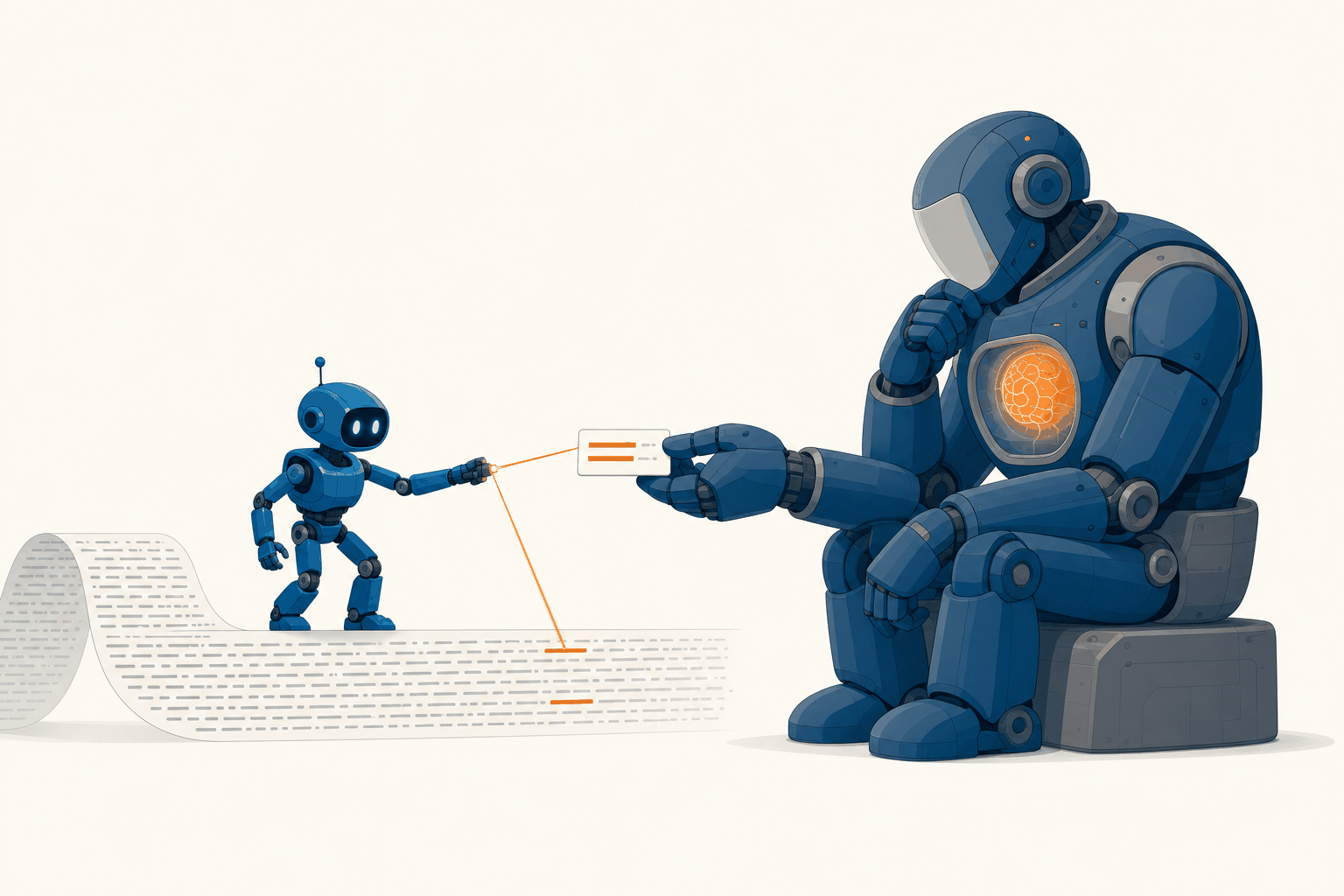
Frontier models earned their place in your stack. They just should not be doing the reading.
The goal is not to replace the big model. It is to stop feeding it haystacks. Budget models miss too much on long inputs, and frontier models charge frontier prices to find what a pointed small model finds for pennies of CPU.
Cheap model finds
Small task-specific models (around 200M parameters, served on CPU) point at the exact evidence in your long inputs. A model that can only point at your document cannot make things up.
Expensive model thinks
The frontier model keeps doing what it is uniquely good at: judgment, disambiguation, composition. It receives only the context its prompt actually needs, and stops paying to rediscover where the evidence is.
Never degrade
Any small-model failure falls back to the frontier path automatically. A timeout, a failed validation, an empty serve: that chunk drops to the model you already trust. The worst case is the old cost for one step, never the old quality.
The numbers from our own production system.
We did this to our own product first. These are production numbers from real customer workloads, not benchmarks, and the one model that did not clear the quality gate stays on the frontier path by design.
$6.45 to $1.60
Per-session AI processing cost on our own product
~50% to ~88%
Projected gross margin, checked against measured reality
6 of 7
Task models above .90 recall against human-validated references
208 vs 21
Candidate events our small model found vs a budget LLM on the same 3.2-hour recording
What we actually do.
Audit the pipeline
We map every model call and separate the thinking from the finding. Most long-input pipelines pay frontier prices for reading, not judgment.
Train on your own data
Your logged model inputs and outputs are a training corpus you already bought. We distill small task-specific models from it, so the quality bar is your quality bar.
Ship behind fallbacks
Models serve only after clearing recall gates on human-validated references, run in shadow against live traffic first, and sit on a never-degrade rule the pipeline enforces mechanically.
Leave you the tooling
Shadow metrics, replay harness, and the models themselves. Your data and your models stay yours. This is IP you own, not another per-token dependency.
You probably have all three of these already.
Your AI bill scales with your revenue
Every new customer makes the model spend bigger at the same rate it makes revenue bigger, and gross margin is stuck where the frontier bill put it.
You process long inputs
Documents, recordings, tickets, contracts, logs. Multi-hour transcripts and hundred-page files where attention spreads thin and output limits quietly cap what comes back.
You have history
Months of logged frontier calls with inputs and outputs. That archive is training data you already paid for. You are just not using it yet.
We wrote down exactly how we do it.

Cheap Model Finds, Expensive Model Thinks: How Small Neural Networks Fixed Our Frontier LLM Economics
The full engineering story behind this page: the tier gradient, the residue pattern, the quality gates, and the unit economics, with the real numbers.
Read the article
The End of the Context Window: Why AI Memory Is About to Become Three-Tiered
Why long-context reading degrades for structural reasons, why a bigger advertised window does not mean better reasoning, and where model memory goes next.
Read the articleWant to know what your pipeline's version of $6.45 to $1.60 looks like?
Bring your model bill and a description of the pipeline. We will tell you which steps small models can own, what the training data situation looks like, and what phase one costs. That read is free, and engagements start at $4k.